What Is GEO, SEO and AEO? A Simple Guide to Getting Found in 2026
17 Nov, 2026
8 min read
Searching has evolved. Users still type queries in Google, but also ask ChatGPT, Gemini, Perplexity, and voice assistants to get the answer, often not clicking any link. In the case of brands, one marketing approach is no longer enough.
Searching has evolved. Users still type queries in Google, but also ask ChatGPT, Gemini, Perplexity, and voice assistants to get the answer, often not clicking any link. In the case of brands, one marketing approach is no longer enough. SEO is needed to rank, AEO to get an answer, and GEO to get cited and recommended by AI.
At The Branq, we see this trend every day. Brands ranking high in Google may be completely invisible in the AI’s answer, whereas smaller and less-known brands that have a clearer content strategy are being mentioned instead. In this guide, you’ll find out what each of these concepts means and how they’re different from each other.
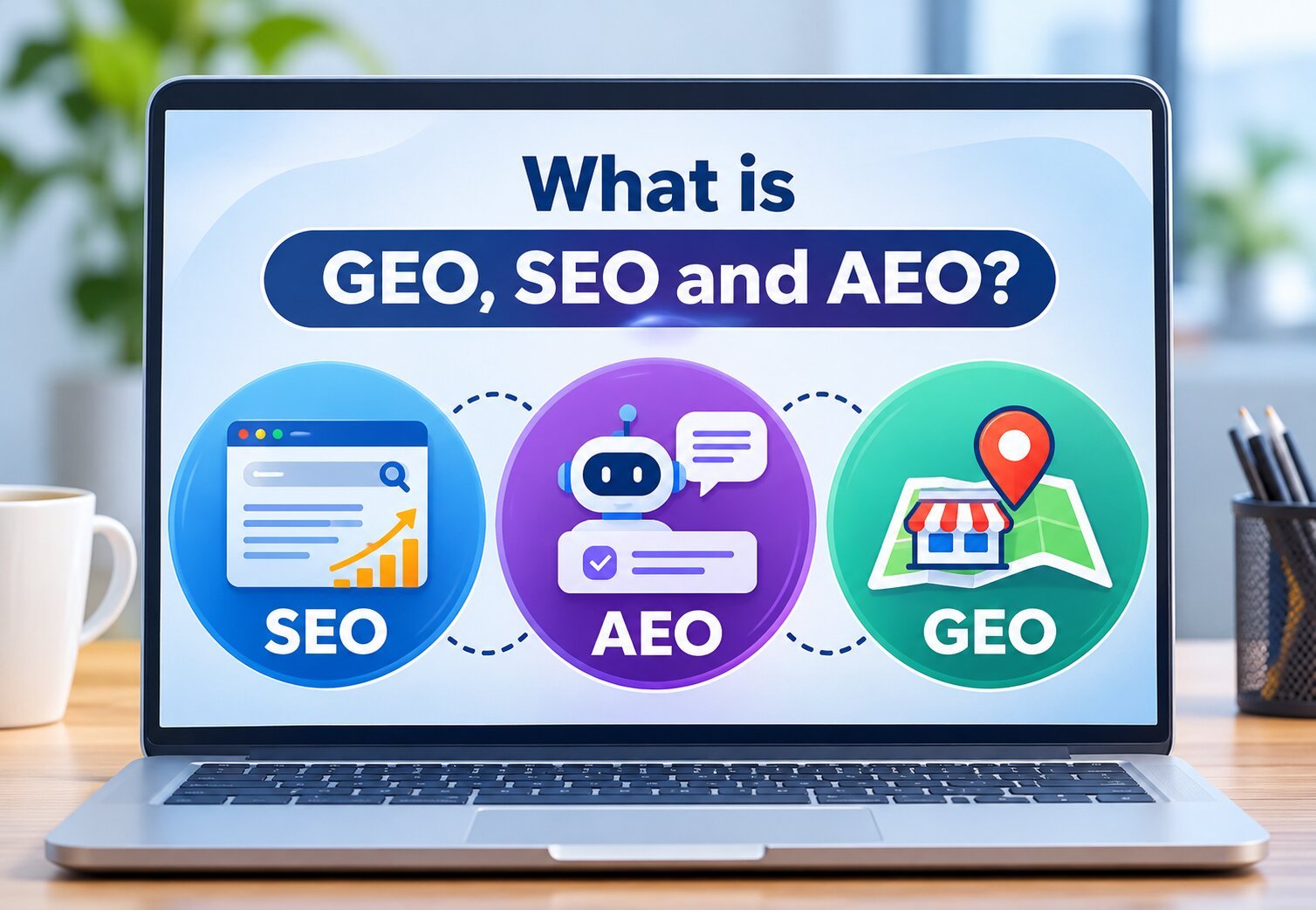
Quick Answer: What Are SEO, AEO and GEO?
SEO improves your website so it ranks higher in traditional search results on Google and Bing.
AEOstructures your content so search engines and voice assistants can pull it out as a direct answer, such as a featured snippet or a "People Also Ask" result.
GEOoptimizes your content and brand presence so AI tools like ChatGPT, Gemini, Perplexity and Google AI Overviews understand, trust and cite you.
In short: SEO gets you ranked, AEO gets you quoted, and GEO gets you recommended.
What Is Search Engine Optimization (SEO)?
Search engine optimization is the backbone of online visibility. This is the process by which the website is optimized technically and for its content and authority to rank better in search results for specific keywords.
SEO rests on three pillars:
Technical SEO: crawlability, site speed, mobile-friendliness, Core Web Vitals, clean URLs and XML sitemaps.
On-page SEO: keyword research, title tags, meta descriptions, headings, internal links and genuinely helpful content.
Off-page SEO: backlinks, brand mentions, local listings and customer reviews.
Why does this matter today? Search engine answers and artificial intelligence tools frequently refer to websites that are already indexed and credible. The lack of search engine optimization means that AEO and GEO have very little to go on.
What Is Answer Engine Optimization (AEO)?
SEO for answer engines is all about making sure that your content is picked to be the sole, straightforward answer to a query. The difference between ten blue links and a singular answer means that there’s just one: a featured snippet, “People Also Ask,” knowledge panel, or voice assistant response.
Here is how answer engine optimization works in practice:
Target questions, not just keywords. Think "how", "what", "why", "best" and "near me" queries.
Answer first. Place a clear 40–60 word answer directly below the question heading.
Use structure. Lists, tables and step-by-step formats are easy for machines to extract.
Add schema markup. FAQ, HowTo, Product, LocalBusiness and Article schema help search engines understand your page.
Write conversationally. Voice queries are longer and more natural, so match that tone.
Example: "Teeth whitening costs in Delhi" on a dental clinic page where the information is mentioned in the second sentence has a much higher likelihood of becoming the featured snippet compared to a page where the price is hidden in the sixth paragraph.
What Is Generative Engine Optimization (GEO)?
Generative Engine Optimization represents the latest stage of search marketing development. This is a new approach to optimizing your brand’s presence in AI-generated content: specifically in ChatGPT, Google AI Overviews, Gemini, Perplexity, Microsoft Copilot and other similar platforms.
Such tools do not use traditional page ranking. Instead, they read a lot of sources, combine the information in one answer and sometimes even refer to a particular brand name. That’s what generative engine optimization is for.
Key GEO tactics include:
Build entity clarity. Keep your brand name, description, services and location consistent across your website, Google Business Profile, LinkedIn and directories.
Publish original insight. Data, case studies, expert quotes and frameworks give AI tools something new to reference.
Earn third-party mentions. Reviews, industry publications, podcasts, forums and "best of" lists shape how AI models describe you.
Write in self-contained sections. Each section should make sense on its own, so it can be lifted straight into an AI answer.
Show E-E-A-T. Author bios, credentials, cited sources and updated dates signal experience and trust.
Track AI visibility. Regularly ask AI tools the questions your customers ask, and note whether and how your brand appears.
SEO vs AEO vs GEO: Key Differences
Factor
SEO
AEO
GEO
Main goal
Rank in search results
Be the direct answer
Be cited or recommended by AI
Platforms
Google, Bing
Featured snippets, PAA, voice assistants
ChatGPT, Gemini, Perplexity, AI Overviews
Content style
Keyword-focused pages
Short, question-and-answer format
Authoritative, factual, well-structured
Key signals
Backlinks, technical health, relevance
Schema, formatting, clarity
Brand mentions, entity consistency, originality
Success metric
Rankings, organic traffic
Snippets won, voice visibility
AI mentions, citations, share of voice
How SEO, AEO and GEO Work Together
These are not competing strategies. They are layers of one system:
SEO is the base. Without crawlable, fast and trusted pages, nothing else works.
AEO is the middle. It shapes your content into clear answers that machines can extract.
GEO is at the top. It builds the authority and brand presence that make AI tools trust and recommend you.
This blog post can do all of these in one fell swoop. It will rank due to SEO on account of the keyword used. It will get the featured snippet due to answer engine optimization with a concise definition. And finally, it will be quoted in the AI Overview as part of generative engine optimization.
A 7-Step Action Plan for Your Brand
Audit your foundation. Fix technical issues, page speed and mobile experience.
Map customer questions. Use "People Also Ask", sales calls, support tickets and AI chat prompts.
Restructure key pages.Add question-led headings, answer-first paragraphs and FAQs.
Add structured data.Implement FAQ, Organization, LocalBusiness, Product and Review schema.
Strengthen your entity. Align your name, address, services and descriptions everywhere online.
Publish proof. Share case studies, original data and expert opinions.
Measure all three. Track rankings and traffic, snippets won, and AI mentions.
Common Mistakes to Avoid
Treating GEO as a replacement for SEO. It isn't; it depends on it.
Keyword stuffing.Modern search engine optimization rewards clarity, not repetition.
Long intros before the answer.Answer engines skip pages that make them hunt.
Ignoring your off-site presence. Generative engine optimization relies heavily on what others say about you.
Never updating content.Outdated pages lose trust with both people and algorithms.
Frequently Asked Questions
What is the difference between SEO and GEO?
SEO will help your page to appear on the SERP whereas GSO will help your brand to be mentioned and cited in the answers generated by artificial intelligence platforms such as ChatGPT and Google AI Overviews.
Is AEO the same as SEO?
Answer engine optimization is a specialized branch of SEO concerned with getting direct answers, including featured snippets and voice searches. Answer engine optimization is based on SEO, however, it requires concise, question-driven content as well as schema markup.
Do I still need SEO if AI search is growing?
Sure. AI and question-answering bots depend on good indexing of reputable websites, so SEO is fundamental to AEO and GEO as well.
How long does GEO take to show results?
This is dependent on different situations. However, many brands experience changes within several months as the AI systems learn new material. Speed is less important than consistency.
Can a small business use AEO and GEO?
Absolutely. Search answer optimization is particularly budget-friendly, as creating FAQ pages, local schema, and direct answers to customers' questions are some of the most budget-friendly ways for a small company to become visible via both search and AI technology.
Conclusion: Be Visible Wherever Your Customers Look
We do all three—search, ask, and chat—and each requires its own strategy. Companies that implement SEO, AEO, and GAO will appear in Google results, featured snippets, and within AI suggestions. Those who just focus on their ranking will end up being absent from where it counts—the conversation.
The good news is that you don’t have to develop three strategies. You have to develop one strategy based on a solid SEO foundation that is tailored for answers and AI trust.
Ready to Get Found on Google and AI Search?
The Branq assists brands in creating integrated SEO, AEO and GEO strategies to boost their rankings, featured snippets and AI citations. Schedule a free visibility audit and find out where you stand today.